new blog post

Is this awesome or what?

The eco friendly, paper wine bottle from Greenbottle
Will Wine Snobs Embrace a Paper Bottle? Gizmodo
Cardboard wine bottle promises to uncork carbon savings – Business Green
“…an innovative new design from UK start up GreenBottleis promising to slash the carbon footprint of wine bottles by around 90 per cent.The prototype “paper” wine bottle is made from a combination of cardboard and ultralight plastic, which according to GreenBottle reduces the weight of typical wine bottles from 500g to just 50g, resulting in huge energy savings during manufacture and further carbon savings when the wine is transported.
The cardboard can also be easily separated from the plastic, making it easy for users to recycle the bottle when it has been used.”
Reducing waste and transportation costs are cool. Providing a whole new surface for message storytelling presents a lot of branding opportunities. What I find awesome about this story is it exemplifies the entrepreneurial process. In short, Greenbottle has found a potentially huge opportunity where few were looking. They found it where most were content for the status quo. They asked the right questions.
It was very much a Blue Ocean approach.
It looks like they are into milk too:

Awesome
The idea of government workers hanging at coworking spaces has a lot of merit. The is definitely good in theory but a huge is design flaw is Government, or the system’s ability to handle a more freelance and freestyle workforce. After all this is an institution whose purpose is to maintain order, the status quo and is generally secretive. Labour is very highly organized and fixed with FTEs, classifications and unions.
The answer though might be out there. In fact it might be in the cloud.
I was first introduced to the concept of the ‘cloud based’ Federal civil service in this recent piece in the Ottawa Citizen: ‘Cloud’ Public Service workers could cut costs: Use roaming staff, consultant says.
The head of research for the consulting giant advising the Conservatives on how to save money is calling for a public service of “cloud” workers, free agents who don’t work for departments and roam from project to project.
William Eggers, the global director for sector research at Deloitte, said a FedCloud workforce, modeled after cloud computing, could be years away, but it’s the kind of fundamental rethinking or “rebooting” of the public service that technology offers. Instead of information, the cloud would house people.
#FedCloud
It is not about using Google docs, but about how we better utilize the current and future talent in the public service. It is the kind of flexible, dynamic and adaptable talent and knowledge management system that could readily and effectively utilize a physical coworking space.
The #FedCloud idea also seems to be generating an enthusiastic response, especially from the Gen Y demographic that is the bread and butter of the coworking movement.
Mr. Eggers and the incredibly smart people at Deloitte are leading the charge on Cloud based public service. Here is their discussion paper The Future of the Federal Workforce: Putting FedCloud to work.
What I find inspirational is not only the goal of good government, increasing efficiency, lowering costs and solving the big problems, but actually making government work “cool”.
Twitter lit up with comments from the audience during [Eggers] presentation. “I want to work there,” tweeted one public servant.
Is FedCloud the ‘social OS’ required to both effectively utilize coworking spaces and develop a compatible culture (hacker/bureaucrat)?
Is Coworking a new model for internal government offices in a Cloud environment?
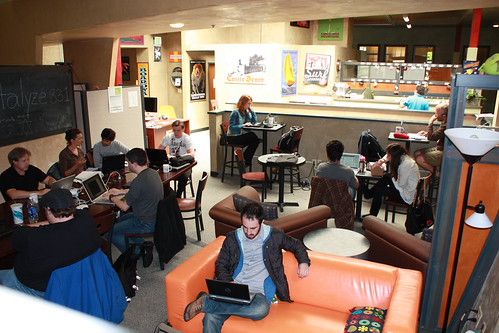
Deskmag recently posted a great article entitled 10 Things to tell the Government about Coworking .
“If you had half a day with your government’s department of economics, what would you say about coworking on a national level? Deskmag was recently given this opportunity by the City of Berlin. They asked us to provide a list of “ten things the government can do for coworking”. We threw the question open to the Coworking Europe conference participants during an open camp session. Here is a first summary of the recommendations that emerged. We are also open for more proposals.”
The session obviously provided a lot of solid feedback.
1. Easier access to empty spaces
2. Government officers give information sessions
3. Educate bureaucrats about coworking
4. Using the government network in order to promote coworking
5. Easier bureaucracy for independents
6. Supporting the start of smaller businesses by rewards or grants
7. Funding of education programs in universities
8. Educate would-be coworking space founders
9. Don’t fund single coworking spaces more than others
The 2nd point included a line about government employees being dispatched to coworking spaces “to work, either as paying members or as drop-in advisors giving information sessions.” I found this idea to have interesting potential given my background in the civil service. But experience has also shown that best way to increase public resources and support for one’s cause (say coworking) is to to answer the question: “What’s in it for them (the Government)?”
As a civil servant on leave, who is working with a group to develop a coworking space, the idea of merging those worlds had obvious appeal. But more importantly, I think it could have appeal to my bosses, and their bosses, and their bosses (the elected officials) and their bosses, (the citizens).
Could coworking be an effective weapon to reinvent government?
What are some of the potential benefits to government/government workers supporting coworking spaces?
Thinking about what problems are solved is key to understanding the benefits. “What are some of the ‘big problems’ facing government?” I am writing from a small province in Canada, but I suspect the problems are universal. If coworking isn’t part of the solution, then it won’t get on the radar.
Problems:
But despite all those challenges, governments still have the resources, critical mass and most importantly a mandate.
So what are the benefits to government?
Tool to accomplish Mission: Coworking can be a tactic to help support rural & youth employment, high tech start ups, rural economic development, downtown revitalization and many other high level policy objectives.
Shared Risk: It is not only effective, but as the movement has legs already. The risks to government are minimized (it is generally risk adverse). As there is already a lot of private capital, NGO energy and collective wisdom behind the movement, government $ at this time would be leveraged and could help push things over the top. Government wouldn’t be in the position of innovator, instigator or pioneer.
Cost Effective: Government workers having coworking memberships/hot desks could be a cost effective service delivery alternative to dedicated, permanent offices. Less money spent on overhead can equal more money for staff, programs or simply less overall costs. Government could still maintain dedicated offices, but offices could be hot desked or shared at the office as staff spend some time at the coworking space. It could also be a way to look at different ways to structure a workforce using freelancers, cloud workers and teams.
Connections outside government: One of the greatest design flaws in government is the tendency to exist in a bubble. Civil servants tend to engage mainly with other civil servant due to proximity. Government staff working out of coworking spaces would get the deliberate and incidental contact with entrepreneurs, NGOs, hackers, and freelancers. Conversations and stimulation would be different than in the government only office. There would also be opportunities for collaboration, outsourcing and identification of projects and cutting edge ideas. While there is much talk about government trying to go Gov 2.0, there would be inevitable benefits by hanging with people whose business is and have a strong comfort level with 2.0. Policy, programs and resource development can all benefit from diverse perspectives, thinking and input.
Connection within government: A further design flaw in government is “silos”. Departments don’t communicate with other Departments. Branches don’t talk too other branches. It takes a deliberate effort to connect staff from different Ministries like Health, Economic Development and Environment. If staff from different departments hung out at coworking spaces, you would get cross pollination and discussion that wouldn’t occur with the fixed, separate offices.
Decentralization: There is always a pendulum dynamic in government to centralize/decentralize. Right now the dynamic is to decentralize. It is being driven by a number of factors, but namely as an economic development tactic for areas outside of the capital cities. Decentralization also has an impact for the workforce, enabling residency in lower cost of living areas or reduction of commuting. As opposed to the relocation of entire offices or Ministries, embracing a coworking based alternative could be a more widely dispersed and based on the location of workers. In an era of austerity, wage freezes, and claw backs, the opportunity to ditch the 1 hour commute and work closer to home could be a compelling benefit for staff. Decentralization and a leaner, more flexible government is critical for a future involving economic upheaval and energy transition.
Relevance & Rejuvenation: Whether you want to call it a refresh, Government 2.0, becoming a employer of choice or updating an old institution, an embrace of coworking could help government reinvent itself. It could play a role in attracting the best talent, engaging citizens, supporting social innovation and doing more with less. It is a scenario where existing budgets (rent, offices & overhead) are repurposed to not only house workers, but support a whole host of other mission goals. It could help develop and springboard the coworking movement.
From the perspective of the Coworking movement and spaces, civil servant memberships could be a more effective form of support than grants, subsidies or programs. As point 9 in the article stated, a worst case scenario is government supporting one space over an other. Picking winners and losers is not something government does well. It screws with the marketplace and has many unintended consequences. If the support comes in the form of increasing members, then it is based more on the business model, amenities, location and features of the space. Increasing regular, anchor members could improve profitability and space viability. A significant volume increase could lead to the expansion of the movement and spaces.
There are of course risks. What would be the effect on coworking space culture? It is a free radical, social innovation, change the world, freelancer domain. Are government workers a good fit? Would the strategy work only if a voluntary option for workers? Would there be culture shock/conflict? What if recentralization reemerged in 5 years, what would be the consequences?
Coworking is a powerful idea and movement. More positive attention and resources from existing government institutions can help it reach the next level. At the same time, opportunities and synergies abound for the coworking to help government function better, more efficient and be more connected. Win-win is always a great point from which to launch a dialogue.
thoughts?
If you are a space owner, would you want to have government members?
If you are a civil servant, is coworking appealing?
Are the cultures compatable? Can hackers and bureaucrats be roomies?
Welcome to Reinvent Everything. It is my idea work and play space. I have laboured for a long time about getting back into blogging as well as choosing a focus. I have a lot of interests and toes in the water – coworking, farmers markets, demographics, agriculture, economic development, sustainable communities, housing, Government 2.0, entrepreneurship, shared transportation, marketing, business planning, collaborative consumption, food, parenting, heritage, downtowns and education.
Since I couldn’t choose a focus, I have decided not to focus. I have also realized that not only to many of these idea connect and over lap, but adding Problem A to Problem B can result in a mutually beneficial solution.
A lot of the ideas expressed here will be an expansion of the 140 characters found on my twitter feed @jameycoughlin.
After I posted Information in Your Pocket, I received a great note from GS1 with a link to a kick ass whitepaper they published (strangely enough the same day). “Mobile in Retail” White Paper can be downloaded from www.gs1.org/mobile/mir.
Description:
Potential for brands and retailers identified
The white paper explores the opportunities for brands and retailers as consumers begin to use mobile phones to plan their shopping and during visits to stores. It identifies clear potential to:
Key questions answered
By examining the current and future state of mobile services relevant to retail such as extended packaging, mobile coupons, loyalty, store location, shopping lists and self-scanning, the white paper sets out to answer the following questions:
Smartphones like the Apple iPhone, BlackBerry Bold or Google Nexus One have potential to revolutionize the farming and food business. They have the potential to further shrink the distance between urban and rural, buyer and seller, producer and consumer that has been consistently eroding with the advent of the Internet. Smartph0nes are a catalyst to bring the agriculture and food industries into the 21st Century Creative Economy.
They are a tool that provided the right information at the right place and time. The phone is in essence an anywhere connection to the information you need to increase productivity and efficiency, understand consumer demands, document and communicate traceability, maintain and promote freshness, build and reward customer loyalty, increase sales, foster relationships and build Value Chains. It should be noted though, Smartphones aren’t just revolutionizing the farm and food biz. They are revolutionizing everything.
The really exciting thing about Smartphone technology is how fast it is advancing. Each announcement, whether it be the Nexus One or the Apple iPad unleashes new creative uses. The shift to Smartphones from personal computers has coincided with a shift to decentralized and populist software creation, or in other words, the rise of the App. The tagline, “there’s an App for that” it true (140,000 in the roster), and if there is isn’t one, create it.
Here are a few snapshots of the revolution in progress:
 Credit Card Transactions On-The-Go Smartphones enable footloose retail. Whether at a Farmers Market or a pop-up restaurant in a field. No longer are entrepreneurs constrained by the cord to help customers part with their money. iPhone apps for credit card transactions include Process Away and Innerfence. Square Up is offering an innovative hardware solution for physically swiping the credit card.
Linking Buyers and Sellers The Smartphone is enabling the creation of new Value Chains, no matter how short they are. FarmsReach is an innovative online marketplace that connects farmers and chefs. The farmers can use Smartphone to take a picture of what will be harvested shortly and upload a description to the website. Farmers can do their paperwork while out in the field (bonus), chefs can browse the listing at their convenience (likely at midnight). Smartphones can make existing food service supply chains work better, or can make them redundant.
Transparency Documenting the journey, the back-story or the links in the chain has rapidly evolved from a gimmick to a requirement. Concerns about food safety, recalls, production practices and fair pricing is driving the push for transparency. Smartphones put the information in the consumer’s hand at any time and place, but especially while shopping. Smartphones present the opportunity to gather more information, retrace steps, read reviews and make an informed decision.
IBM has developed an iPhone App called Breadcrumbs that will enable consumers to use the built in camera to scan the bar code and get ingredients, nutritional information and recall information. The App is part of a bigger shift towards communications between devices and stuff – the Internet of Things. Smartphones can allow consumers to find out information about the farm that produced the product similar to the Stone-Buhr Flour website. The Italian government operates a service that provides food prices based on a national survey via SMS and iPhone App. rovision of traceability is becoming an expectation. In the words of Harvestmark, a company that provides barcodes and traceability systems:
 “Companies that are transparent about their product’s history help demystify the farm-to-fork process and build trust with fretful foodies,” said HarvestMark. “For Millennial Moms who are tech-native, it’s a no brainer for them to expect their iPhone to connect to farmers they don’t even know. Dialing for data is a high-tech way of thumping a watermelon or squeezing a zucchini.” – Harvestmark
A further consideration of traceability it the rise of the crowd in fact checking, reviews and provision of information. Once upon a time, companies had control. The internet and especially the smartphone has enabled citizens to provide information to each other without filters. A great example of the technology in action is Ski Report. Skiers now have the tools to report on the slope conditions themselves. The result is better information and honesty.
Managing Operations Smartphones can make recordkeeping, task planning and production management more efficient. Software like iFarmer enables farmers to collect information on daily activities in the field, view tasks, and other important information, and run basic reports from the iPhone. The iPhone can manage farm tasks such as Spray, Irrigation, Planting, Observations, Harvesting, and more. Using an iPhone to manage prooduction can increase productivity as all work is done in the field, in real time, as opposed to having to find time to enter the data later.
Automation and Monitoring The Smartphone can connect you with products and processes whereever they are in the world. It might be a simple as turning on the irrigation or opening the greenhouse. It could also be an connected RFID system for shipping containers. Not only will it enable the verification of plant and container authenticity, but the system can monitor and track conditions and locations of products.
Communicating Freshness Bakertweet is a wall mounted box that enables bakeries to tweet when breads and goodies are coming out of the oven. Followers receive a notice on their twitter feed and can pop down to buy what is fresh. Video Trans
Transmitting Location Smartphones can enable mobile entrepreneurs to transmit their location to customers. The Twitter feed from Kogi Korean BBQ has become as addictive as the Korean tacos.
 Customer Loyalty Airmiles and customer loyalty programs can move beyond the card. Motorola’s Mobile Loyalty Solution allow smartphone screens to display a scanable bar code. Moving the program to the phone provides the company with real time information and the consumer with customized specials and promotions!. No more coupons!
So what does the future hold?
All of the ideas above are real and being implemented right now. The next step will be the further implementation of RFID for purchased (no more credit cards) and traceability.
Using smartphones as a way to integrate with social media applications like Facebook and Twitter will continue to narrow the distance between customers and producers, create transparency and the development of new value chains. They are an essential tool in the Creative Food Entrepreneur’s toolbox.
Thanks to Springwise for the connection to many of these ideas.
This blog is loosely based on a presentation I gave at the Scotian Pride 2010 Aquaculture conference.
Extra:
Check out this ‘Smart Dust’ article from the New York Times. It covers the possibility for sensors and smartphones::
“Microchip-equipped sensors can be designed to monitor and measure not only motion, but also temperature, chemical contamination or biological changes. The applications for sensor-based computing, experts say, include buildings that manage their own energy use, bridges that sense motion and metal fatigue to tell engineers they need repairs, cars that track traffic patterns and report potholes, and fruit and vegetable shipments that tell grocers when they ripen and begin to spoil.”
The proliferation of artisan cheese fromageries, Farmers’ Markets, craft wineries, and Community Shared Agriculture (CSA) box schemes is evidence of a creative economy renaissance that impacts both urban and rural communities.
An emerging component of the ‘Creative Economy’ dialogue, ‘Creative Food’ endeavours can be distinguished from a more commodity–oriented agriculture or food service through emphasis in differentiation, connection to the customer, capturing a higher margin, sustainability and collaboration. Innovation, adaptation and entrepreneurship are as characteristic of Creative Food enterprises as other more recognized Creative Class occupations in the design, business service or technology fields. The emergence of Creative Food was well documented in the Martin Prosperity Institute Working Paper – From Kraft to Craft; Innovation and Creativity in Ontario’s Food Economy
The purpose of this article is not to advocate for the further recognition of Creative Food as a category. Instead, the purpose is to promote Creative Food as a tool to develop creative economies, communities and companies.
In short, Creative Food can attract Creative Talent and generate wealth; as such it warrants a place in the CED practitioner’s toolbox. The impacts are both direct and indirect. Here are a few examples:
Brand: Food can play a big role in branding a place. When you think of Italy or France, you think of food. Residents of Prince Edward County in Ontario have done an exceptional job of leveraging natural assets into good food and tourism opportunities. Those Creative Food industries in turn form a significant and visible part of the area’s marketing identity. In a world often characterized by homogeneity, that local microbrew can help a place stand out. Creative Food enterprises are the new status symbols for communities. Vermont has recently explored its terroir, provence, traditions and food identity extensively in the Taste of Place process
Promotion: Creative food is not just consumed locally. Every block of artisan cheese from Vermont inherently markets the state when it is sold in New York City. Good food opens doors, reaches eyeballs and spurs conversation in ways that marketing campaigns can never do. The regional connection can be subversive or overt. Nudo Italia, an Italian olive grove markets itself by enabling customers to “adopt a tree.” In addition to receiving a selection of olive oil products from their tree, customers are encouraged to come to Italy to ‘’hug their tree.”
Differentiation: In the talent war, food can be a secret weapon. A vibrant Farmers’ Market, CSA box schemes, restaurants that feature unique local fare, nearby wineries for day trips or artisan bakeries offering real bread may be the community features that become a deciding factor for a footloose professional. As documented by Rebecca Ryan’s Next Generation Consulting young professionals are looking for ‘cool communities.’ Creative Food, like the arts, diversity, transportation options and green space all contribute to a place’s ‘coolness.’
Diversity: Diversity fosters the Creative Economy. Creative Food is both a catalyst for and an indicator of diversity. Farmers Markets are a venue for newcomers to start a business, with customers interested in unique and ethnic foods. Markets are also places to purchase foods that may not be available from the conventional grocers. A diverse roster of restaurant options can also be an effective attraction and retention tool.
Inclusion: Opportunities to become involved, engaged and valued in a community are as critical for retention as earning potential and professional satisfaction. Social and community relationships are roots. Creative Food industries, by their design, build community. Farmers Markets are as much a social gathering as they are a shopping option. They can serve as a civic square, neo-downtown and public space. CSA initiatives nurture a relationship between a farm and group of customers. Creative Food is an easy way for newcomers to get involved and into a community.
Retention: Creative Food can also be the ultimate perk for companies to retain talent. The Kaiser Permanente HMO in the US operates a number of hospitals. It has organized on–site Farmers Markets and CSA drop offs. Providing a convenient, healthy food option was the major motivation. The hospital working environment was expected to be intense and stressful, but Kaiser was at least able to offer staff more enjoyable breaks (strolling in the market), better use of their off-work hours (less time shopping) and access to fresh, nutritious food. Development of small Creative Food enterprises can often help retain residents in rural communities. It might provide the income supplement or the social fertility required to put down roots, as opposed to moving to urban areas.
Money: Creative Food generates wealth, reduces leakage and can attract and retain capital. It can contribute to a constructive cycle of prosperity attracting talent / talent attracting prosperity. In Nova Scotia, The Halifax Seaport Market and Just Us Coffee Roasters have utilized Community Economic Development Investment Funds (CEDIF) to attract millions of dollars in equity capital. $600 million is annually invested in RRSPs by Nova Scotians – 98% of that amount leaves the province. CEDIFs provide a tool to retain a portion of the investment and put it to work at home. Monforte Dairy in Stratford, Ontario is employing the CSA model to finance the development of a new facility. Capital investments are repaid over the long term in the form of cheese. Creative Food enterprises displace imports and capture spending on food, meals and experience that would normally be lost to external investors. They not only provide an alternative to big box and chain stores, but increase economic spin-off and recirculation of dollars.
Trendy: It is always easier to surf with a wave than against it, and Creative Food is hot. Eating good food, knowing the farmer, telling better stories and celebrity chefs are all contributing factors. The local food trend is backed by other trends for wellness, aging population, mini-preneuring, sustainability and information empowerment. It shows no sign of cresting and is diversifying and morphing.
Possible: Practicality and impact are key considerations when focusing limited resources. Creative Food enterprises can be profitable. Business models, have moved from the experimentation phase and are continuing to develop. Risks are becoming understood and managed. Best practices for resources for business development support – training, business planning, networks, logistics, mentors, incubation and marketing – are also being established. The path for entrepreneurs, communities and development agencies is straightforward. Creative Food enterprises go beyond just Saturday morning Farmers Market stalls. The only limits are imagination and could include preparation of ready meals, urban farms, social enterprises, canning clubs, home party sales, short-haul logistics and pop-up restaurants. Many of the ideas are documented on the SPROUT Enterprise wiki.
Collaboration: Beyond the catalyst role of public spaces like Farmers Markets or occasions like Feast of Fields suppers, Creative Food presents the opportunity to bring numerous and diverse partners to the table. Food intersects with prosperity, poverty, nutrition. healthcare, aging, the arts, downtowns, urban design, immigration, environment, climate change, youth, education and transportation. The list is endless. Food shapes cities, conversations and our bodies. It can be a powerful tool to address the mission priorities of those the sectors. Food has also become a magnet for citizen engagement. It presents opportunities to work outside of traditional silos. In Nova Scotia, representatives from the provincial and federal governments, public health, community organizations, industry, universities and citizens have come together under different umbrellas including the Nova Scotia Food Security Network. In other jurisdictions, Food Policy Councils , Roundtables or facilities like the Intervale Center in Burlington, Vermont or Toronto’s Wychwood Green Barns have served as the intersection for collaboration.
Creative Food presents a myriad of options, rationales and tools to help develop Creative Economies. Creative Food presents direct opportunities for profitability, rejuvenation and renaissance for the agriculture and food sectors. Indirectly, it is a tool that can attract Creative Talent and generate wealth in urban and rural communities. Creative Food provides an opportunity to brand a place, foster diversity and inclusiveness, and facilitate collaboration. The positive ratio between community impact and resource investment further solidifies Creative Food as a tool in the CED practitioner’s toolbox.
cross posted at http://dantaylorcre.tumblr.com/
About the Author: Jamey Coughlin is a Creative Food enthusiast. He can be reached at jameycoughlin@gmail.com

